

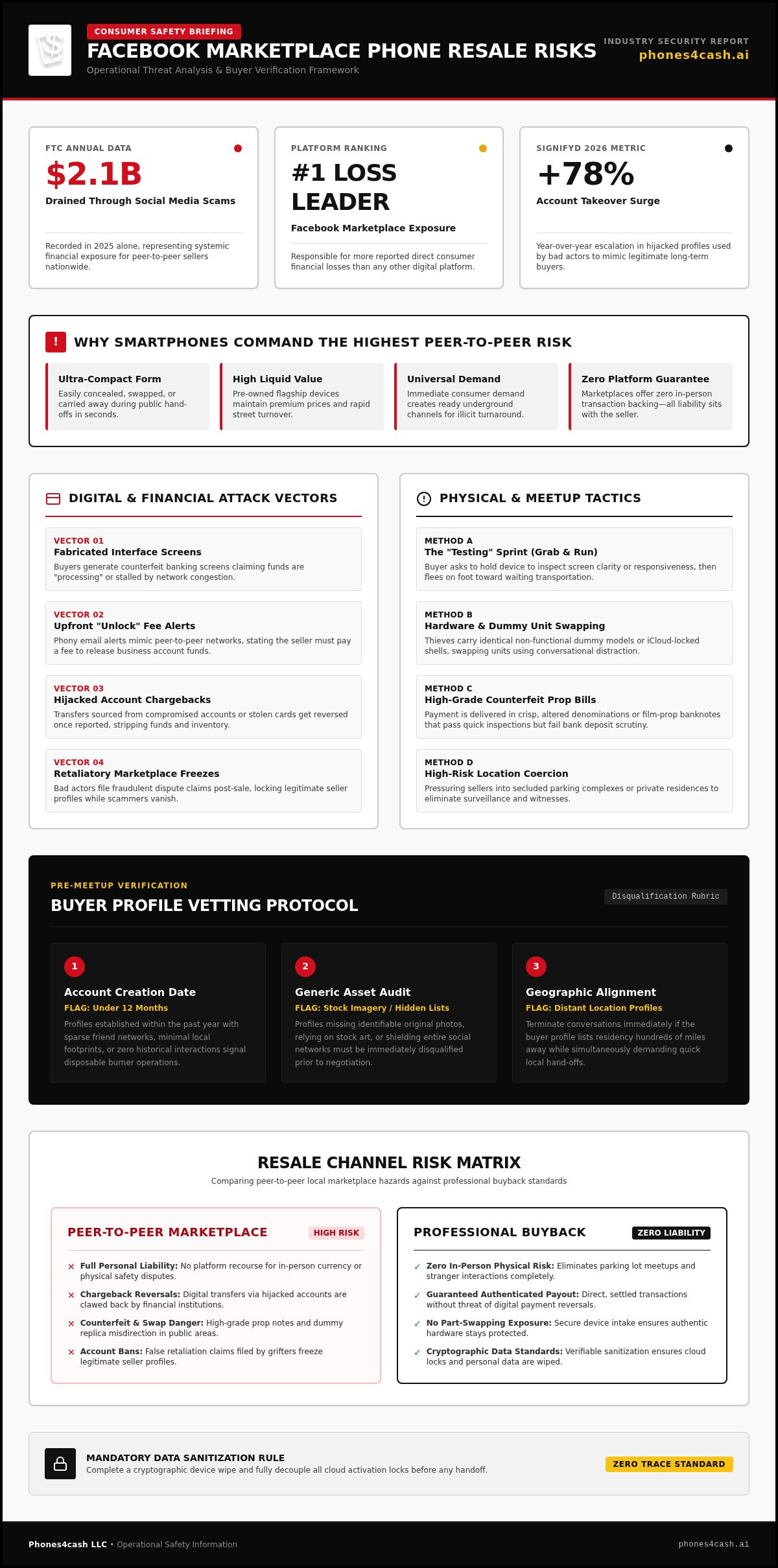
According to FTC data, scams originating on social media drained $2.1 billion in 2025, with Facebook responsible for more reported financial losses than any other platform. If you want to avoid Facebook Marketplace phone selling risks, treating every inquiry with strict operational caution is no longer optional. Selling a pre-owned device shouldn't force you to gamble between turning a profit and facing counterfeit bills, fake digital payment receipts, or high-risk public meetups with strangers.
Master this comprehensive safety checklist to protect your money, identity, and personal safety when selling a phone. In this guide, we break down actionable screening methods for spotting fraudulent buyers, the latest sanitization standards for wiping private data, and practical criteria to decide whether a marketplace sale is worth the inherent liability.
Key Takeaways
- Apply a strict vetting rubric to buyer account age and messaging habits to avoid Facebook Marketplace phone selling risks before scheduling a meetup.
- Spot counterfeit currency and fraudulent digital payment confirmations by enforcing in-person verification rules that leave no room for chargebacks.
- Protect your personal information by completing a cryptographic device wipe and removing all cloud activation locks prior to listing.
- Evaluate whether peer-to-peer selling is worth the personal liability, or if a local professional buyback service offers a safer, zero-friction transaction.
The Primary Facebook Marketplace Phone Selling Risks You Must Recognize
Smartphones represent the highest-risk inventory on any peer-to-peer platform. They are compact, expensive, universally demanded, and easily wiped for immediate resale on the black market. Because modern devices command premium resale prices, bad actors constantly target local listings using targeted schemes. If you intend to online marketplace transactions safely and avoid Facebook Marketplace phone selling risks, you need to understand the exact exposure points inherent to these platforms.
Every transaction carries structural vulnerabilities. When you list a handset locally, you take on personal liability for payment authentication, physical handoffs, and account protection. The platform does not guarantee in-person transactions, meaning all financial and safety risks fall squarely on your shoulders.
Common Financial Scams: Fake Receipts, Overpayments, and Chargebacks
Digital payment manipulation causes immediate, unrecoverable losses for private sellers. Fraudulent buyers regularly generate counterfeit confirmation screens that match standard mobile banking layouts. They display a falsified transfer interface on their own phone, claiming the funds are "processing" or delayed by network congestion. Alternatively, scammers trigger fake email receipts that look like automated alerts from peer-to-peer platforms. These notifications often claim you must pay an upfront verification fee to unlock a corporate account balance.
If you accept peer-to-peer digital transfers from personal accounts, you face severe chargeback risks. Bad actors frequently fund transactions using stolen credit cards or hijacked consumer accounts. Once the legitimate account owner notices the breach and files an unauthorized transaction claim, the payment platform reverses the funds. Your bank reclaims the transfer amount, leaving you without your phone or your cash. Malicious buyers also file false disputes against sellers to freeze their marketplace access, leaving reputable accounts banned while the scammer disappears.
Physical Risks: Theft, Counterfeiting, and Device Swapping
Meeting a stranger introduces physical hazards that no platform algorithm can prevent. Parking lots and private residential meetups expose sellers to aggressive theft tactics that compromise your property and personal safety.
- Grab-and-Run Thefts: Buyers ask to hold the smartphone under the pretense of testing responsiveness or checking screen clarity. Once the device leaves your hands, they sprint toward a waiting vehicle or crowded exit.
- Hardware and Part Swapping: Sophisticated thieves carry identical non-functional dummy units or damaged models. While pretending to inspect your device, they use misdirection to swap your functional phone for an iCloud-locked or bricked replica.
- High-Grade Counterfeit Currency: Buyers hand over stacks of crisp bills that pass casual visual checks. Sellers often discover these are prop notes or altered denominations only after attempting a bank deposit.
Knowing these threat vectors is the first step toward staying protected. To avoid Facebook Marketplace phone selling risks completely, you must implement strict verification rules before handing over any hardware.
Step-by-Step Checklist to Screen Buyers and Avoid Facebook Marketplace Scams
Relying on gut instinct leaves you vulnerable to seasoned online grifters. To avoid Facebook Marketplace phone selling risks, run every prospective buyer through a standardized vetting checklist before confirming a meetup or discussing final numbers. Systematically filtering incoming messages eliminates fraudulent accounts before they consume your time or compromise your physical safety.
Vetting the Buyer's Facebook Profile: Critical Red Flags
Examine the buyer's public account history immediately. According to Signifyd's 2026 data, account takeover fraud attempts surged 78% year-over-year, meaning a compromised account might still show years of older activity. Watch out for these specific profile discrepancies:
- Recent Account Creation: Profiles created within the past twelve months with zero local footprint or mutual connections signal high risk.
- Generic Assets: Accounts utilizing stock imagery, missing profile photos, or displaying hidden friend lists warrant immediate disqualification.
- Geographic Inconsistencies: If the user's profile lists a current city hundreds of miles away while requesting local pickup, terminate the conversation.
Filtering Inbound Messages and Conversational Traps
Automated scripts and professional scammers operate using predictable conversational patterns. Never reply to accounts sending rapid, generic prompts like "kindly send your phone number" or "email me pictures directly." Official FTC consumer advice highlights off-platform communication as a prime sign of financial fraud. Refuse requests to transition chats to third-party encrypted apps or standard SMS, as leaving Messenger forfeits all record logs.
Additionally, disqualify any buyer offering to pay above your asking price in exchange for rushed overnight shipping or unprompted courier pickup. Legitimate local buyers negotiate down, not up. Overpayment offers almost universally signal fraudulent digital transfers or stolen banking credentials.
Establishing Non-Negotiable Seller Terms Before Meeting
Set operational boundaries in writing before agreeing on an exchange location. State explicitly that all payments must be verified before the device leaves your physical control. Communicate that the buyer may inspect the screen, casing, and basic settings, but you will hold the device during basic demonstrations to prevent snatch-and-run tactics. Finally, enforce a two-hour expiration limit on holds. Serious buyers show up promptly; prolonged delays usually indicate a non-committal user or a scripted bot attempting to test your availability.
If screening dozens of volatile peer-to-peer inquiries feels too time-consuming, evaluating a professional smartphone buyback service offers a verified, zero-risk transaction with certified evaluations instead of dealing with marketplace uncertainty.
Securing Payment: How to Protect Your Money During In-Person Hand-Offs
Handing over a smartphone before securing non-reversible funds leaves you entirely unprotected. To avoid Facebook Marketplace phone selling risks, your payment verification protocol must be rigid and complete before the buyer takes physical possession. Platforms offer zero mediation for private, local handoffs, meaning you must act as your own fraud prevention department.
Every payment method carries distinct operational trade-offs. While electronic peer-to-peer transfers seem modern and fast, they lack the immediate finality required for private electronics sales. Understanding how these payment mechanisms function protects you against predatory chargebacks.
Physical Cash Transactions: Counterfeit Detection Protocols
Physical cash remains the safest medium for in-person transactions, but only if you actively authenticate each banknote. High-value consumer electronics attract modern counterfeit bills that closely mimic real currency. Implement these tactile and visual checks before concluding any deal:
- Use a Detection Pen: Mark every large denomination using an iodine-based counterfeit detector pen. A clear or light yellow mark confirms authentic wood-free paper, while dark lines reveal standard printer paper.
- Inspect Built-In Security Features: Hold $20, $50, and $100 bills up to ambient light to confirm the embedded vertical security thread and the matching watermark portrait. Tilt the note to verify that the numeral in the lower right corner shifts color.
- Meet Inside a Financial Institution: Conducting your transaction directly inside your local bank branch allows a teller to deposit and authenticate the paper currency before you hand over the hardware.
Digital Peer-to-Peer Payments: Avoiding Irreversible Reversals
Digital applications introduce post-sale liability. The FTC guide to avoiding online selling scams warns sellers against trusting outbound confirmation emails or SMS alerts. Fraudulent buyers regularly trigger spoofed notification emails stating money is held pending shipment tracking or third-party fees. Never accept a buyer's screen as proof of payment.
If you choose to accept an electronic transfer, open your standalone banking or payment app independently. Check your posted ledger balance rather than pending notifications. Even when a balance displays immediately, payments sourced from compromised external checking accounts or stolen credit cards face eventual clawbacks once the true owner reports the fraud. Banking institutions resolve unauthorized transaction disputes by removing the funds from the recipient's account, leaving you with zero recourse.
Never accept deposits to "hold" a device unless you consider the funds final. Establishing cash-only terms verified directly inside a bank branch remains your best defense to avoid Facebook Marketplace phone selling risks during handoffs.
Device and Data Preparation Checklist Before Listing Your Smartphone
Failing to prepare your hardware properly exposes your private identity and invites post-sale disputes. If you want to avoid Facebook Marketplace phone selling risks, complete every stage of sanitization and documentation before publishing an active listing. Handing off a smartphone that still links to your digital ecosystem can lock out the buyer or compromise your personal banking and email credentials.
Account Decoupling: Removing iCloud, Google, and Carrier Locks
A simple factory reset does not automatically decouple cloud security systems. Under NIST Special Publication 800-88 Revision 2, sanitizing modern smartphones relies on Cryptographic Erase (CE) protocols rather than repetitive overwriting passes. For Apple and Android devices, this requires manually signing out of Apple ID or Google accounts first. This step disables Find My iPhone and Google Find My Device, ensuring the device clears its activation lock.
Next, contact your network carrier to confirm the handset is completely paid off and globally unlocked. Unlocking your device eliminates post-sale friction where an angry buyer demands a refund because their SIM card fails to register.
Hardware Identity Protection: Recording IMEI and Serial Numbers
Protect yourself against false return claims and internal component harvesting by archiving your device's exact profile. Execute these documentation steps before meeting anyone:
- Log Hardware Codes: Record the IMEI, MEID, serial number, and battery health percentage in an offline document.
- Photograph Physical Condition: Capture clear images of the screen, housing, and ports next to a current date marker.
- Obscure Public Identifiers: Blur full IMEI numbers in your public listing photos. Dishonest users can copy visible IMEI details to submit fraudulent carrier insurance claims or blacklist your hardware.
Selecting Safe In-Person Hand-Off Locations
Never agree to meet a buyer at your residence or an isolated parking lot. Arrange exchanges exclusively at designated police department safe exchange zones, which provide 24-hour recorded surveillance and emergency personnel nearby. If you are arranging a transaction in Butler or Hamilton counties, contact local municipal stations to confirm access to their monitored exchange areas. Always bring a companion and inform someone of your schedule beforehand.
If you prefer skipping the stress of staging public meetings and managing account decoupling on your own, consider working with a professional buyback specialist. You can sell your smartphone for cash directly through a local brick-and-mortar provider, ensuring verified evaluations, immediate payment, and total privacy protection.
Facebook Marketplace vs. Professional Buyback: Choosing the Safest Resale Method
Listing directly on social channels might look like the quickest path to pocketing full retail value, but headline sale figures are deceptive. When you decide to avoid Facebook Marketplace phone selling risks, you have to measure the gross payout against the actual time, fuel, and personal liability involved in managing a private transaction yourself.
Calculating the Hidden Costs and Stress of Peer-to-Peer Selling
Selling through community platforms introduces friction that quickly erodes your profit margins. Consider the practical resources required to close a single private sale:
- Wasted Time: Hours spent filtering lowball bids, answering scripted bot inquiries, and waiting for prospective buyers who ultimately fail to show up.
- Logistical Expenses: Fuel costs and driving time spent traveling to designated municipal exchange locations or bank lobbies.
- Direct Financial Exposure: The statistical hazard of total capital loss from counterfeit cash, stolen accounts, or fraudulent chargebacks.
- Personal Strain: The stress of managing aggressive price haggling on the spot while keeping physical custody of an expensive device.
When an unverified buyer backs out at the last minute or disputes a transaction weeks later, any perceived price advantage vanishes immediately.
The Local Professional Buyback Alternative
Opting for an established electronics buyback business eliminates peer-to-peer liabilities entirely. Rather than coordinating unpredictable meetups with strangers, you bring your device into a verified brick-and-mortar facility. Professional technicians run standardized diagnostic services to evaluate cosmetic and functional health on the spot, providing a transparent assessment without haggling.
Crucially, commercial buybacks offer immediate cash payouts with finality. Once the exchange is complete, you walk away with verified funds; there are no pending digital transfers, zero risks of chargebacks, and no threat of post-sale buyer harassment. For sellers across Cincinnati, Mason, Westchester, and Fairfield looking to avoid Facebook Marketplace phone selling risks, local buybacks deliver a predictable, safe, and efficient outcome.
Sell your smartphone securely at Phones4cash to skip the marketplace headaches, safeguard your personal security, and walk out with verified payment in hand.
Execute Safe Phone Sales Without the Liability
Protecting yourself during a private electronics sale comes down to discipline and preparation. If you choose to navigate local listings, you can avoid Facebook Marketplace phone selling risks by vetting buyer profiles rigorously, demanding verified cash inside monitored exchange spots, and decoupling your cloud accounts prior to the meeting. Sticking to these non-negotiable boundaries prevents you from absorbing avoidable financial losses.
You don't have to carry the burden of screening strangers and preventing scams alone. Skip marketplace risks and get instant cash for your phone at Phones4cash. Visit our walk-in locations across Cincinnati, Mason, and Fairfield for certified diagnostic evaluations, professional device assessments, and guaranteed instant cash payouts with zero chargeback risk. You can turn your pre-owned hardware into verified funds today without sacrificing your time or personal security.
Frequently Asked Questions
Is it safe to accept Zelle or Venmo when selling a phone on Facebook Marketplace?
No, accepting personal transfers through Zelle or Venmo carries substantial financial risk during private electronics sales. These platforms do not provide seller protection for in-person transactions. If a scammer funds the transfer using a compromised bank account or a stolen credit card, the issuing financial institution will reverse the transaction once the fraud is detected. That leaves you without your phone and forces your account balance into the negative.
What should I do if a Facebook Marketplace buyer asks for my phone number?
Refuse the request immediately and insist on keeping all correspondence inside Facebook Messenger. Fraudulent buyers request personal telephone numbers to execute Google Voice verification code scams or transition you away from the platform's automated chat monitoring. Moving conversations to SMS strips away digital records that help you document fraud. If a prospective buyer refuses to communicate through the native Messenger app, disqualify the user and move on.
Where is the safest physical location to meet a buyer from Facebook Marketplace?
The safest meeting spot is a designated police department safe exchange zone or a local bank lobby. If you live around Cincinnati, Mason, Westchester, or Fairfield, schedule meetups outside municipal police stations equipped with 24-hour recorded video surveillance. Meeting inside a bank provides an alternative secure environment where tellers can authenticate cash deposits immediately, helping you avoid Facebook Marketplace phone selling risks before transferring ownership of the hardware.
Can a buyer reverse a payment after taking my phone on Facebook Marketplace?
Yes, buyers can easily reverse digital transactions days or weeks after walking away with your phone. Peer-to-peer applications and credit card companies prioritize account holders who report unauthorized charges or identity theft. Once the actual owner files an unauthorized transaction claim, the platform claws back the transfer amount directly from your linked account. Because peer-to-peer handoffs lack tracked shipping proof, sellers almost never win these formal payment disputes.
How do I prevent a buyer from claiming my phone was broken after the sale?
Draft a concise, physical "as-is" bill of sale that documents the phone's model, storage capacity, and serial number. Before handing over the device, require the buyer to test basic functions like cameras, speakers, Wi-Fi connectivity, and touchscreen responsiveness in front of you. Once they inspect the phone, have them sign the document acknowledging that the device was fully functional and transferred in inspected condition with no warranty.
What happens if someone gives me counterfeit cash on Facebook Marketplace?
You lose both your hardware and your money permanently. Neither your bank nor local law enforcement will compensate you for accepting fake currency. If you attempt to deposit counterfeit banknotes at a financial institution, tellers must confiscate the bills and submit a formal report to the United States Secret Service. To avoid Facebook Marketplace phone selling risks tied to fake currency, always inspect watermarks using a counterfeit pen.
Why do buyers ask for my device IMEI number before meeting?
Legitimate buyers request the 15-digit IMEI number to confirm the smartphone hasn't been blacklisted due to theft, unpaid network financing balances, or carrier loss claims. However, sharing the full unmasked identifier publicly invites malicious actors to clone your device data or submit fake insurance claims against it. Provide only the first 8 to 10 digits or offer to verify the status together in person.


